You are at a desk, a half-empty bottle by the keyboard. A friend says, “Have you had your eight glasses today?” You feel a flicker of guilt. You have had maybe three.
Eight glasses is one of the most repeated health numbers in America. So who counted? We followed it back to a government nutrition panel, a single line of text, and a sentence nearly everyone skipped.
The claim
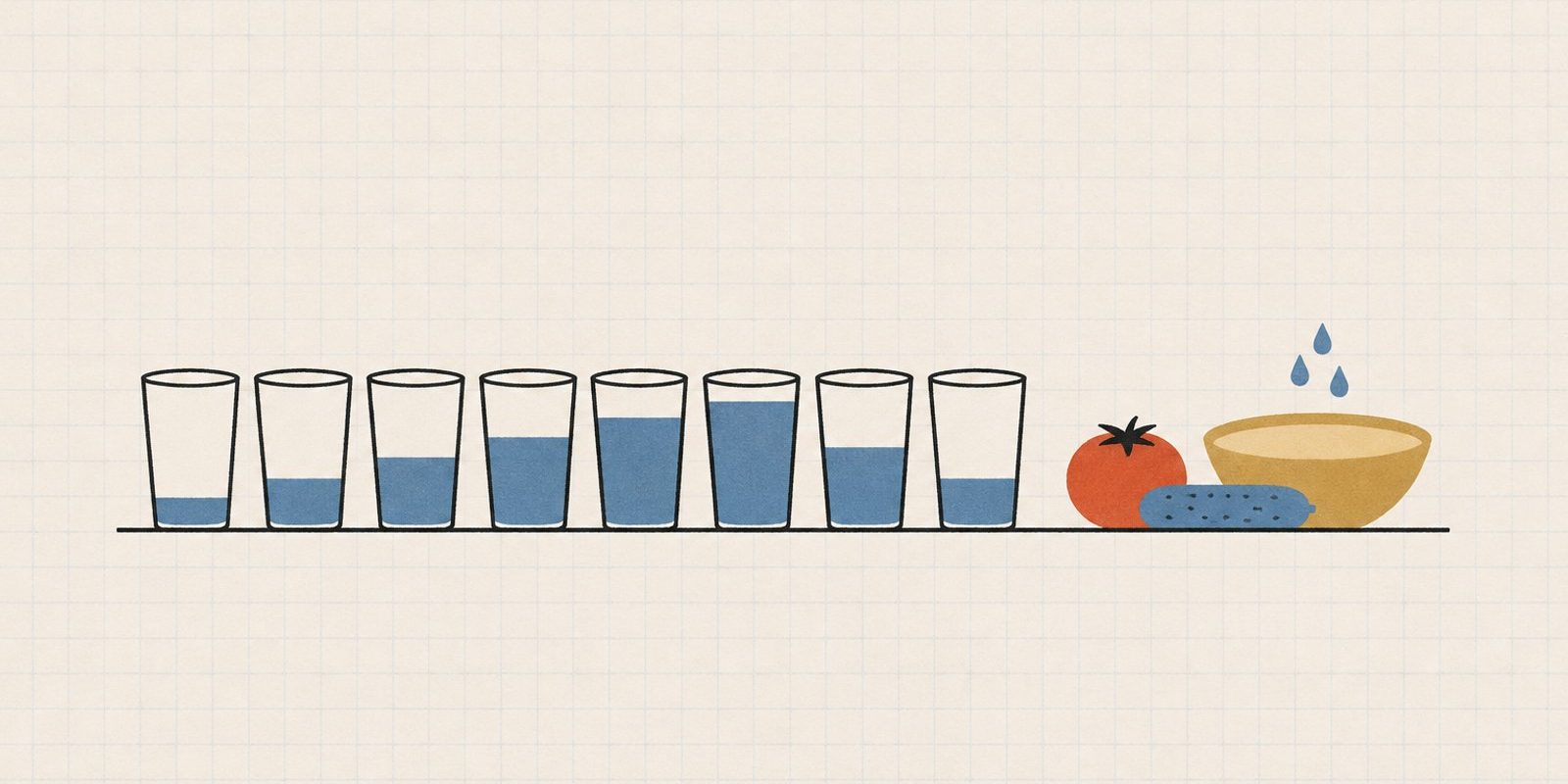
The claim: you should drink eight 8-ounce glasses of water every day. That is 64 ounces, or about 1.9 liters. Sometimes it comes with a rule that coffee and tea do not count.
The trail: a 1945 booklet
The trail leads to 1945. That year the Food and Nutrition Board of the US National Research Council published its Recommended Dietary Allowances. It suggested that a person consume about one milliliter of water for each calorie of food. For a 1,900-calorie diet, that is about 1,900 milliliters (Scientific American, 2009). That is within a few ounces of “eight glasses.”
The recommendation covered total water from all food and beverage sources, not only plain water (Stookey and Kavouras, Nutrients, 2020).
The sentence nearly everyone skipped
Here is the detective moment. In 2002, Dartmouth physiologist Heinz Valtin set out to find the origin of “8 x 8” and any science behind it. He found no scientific studies in support of it (Valtin, American Journal of Physiology, 2002). He suggested the advice may come from a misreading of the 1945 statement. The Board’s next sentence said that most of this quantity is contained in prepared foods, and that sentence may have been missed (Dartmouth Medical School, 2002).
In plain terms: the original note said “you need about this much water in a day.” It also said “most of it already comes in your meals.” The second half fell away. What survived was a tidy round number that sounds like a chore.
No scientific studies were found in support of 8 x 8.
Heinz Valtin, Dartmouth Medical School (American Journal of Physiology, 2002)
What the National Academies said in 2004
In February 2004, the National Academies (then the Institute of Medicine) issued Dietary Reference Intakes for water. They set “adequate intake” levels based on what healthy Americans actually consumed in national surveys. For adults 19 to 30, that is about 2.7 liters (91 ounces) a day of total water for women and 3.7 liters for men. “Total” means drinking water, other beverages and the water in food (National Academies, 2004).
Food supplies about 20 percent of it, according to the same release. The rest, around 81 percent in the survey data, came from fluids: about 2.2 liters (74 ounces) for women and 3.0 liters for men (Institute of Medicine, 2005). The panel also said the vast majority of healthy people adequately meet their daily hydration needs by letting thirst be their guide. And it said, “We don’t offer any rule of thumb based on how many glasses of water people should drink each day.”
| Item | 1945 guidance | 2004 report |
|---|---|---|
| Basis | 1 milliliter per calorie | Median intake of healthy people in US surveys |
| What counts | Water from all sources, including food | Drinking water, beverages and food moisture |
| Rule of thumb | Often retold as eight glasses | None offered; thirst as the guide |
The twist: the 2004 number is bigger
This is where a lazy debunk goes wrong. The 2004 total, 2.7 liters for women, is bigger than 64 ounces. So “eight glasses is too much” is not the lesson. The lesson is that the number was never about glasses of plain water, and it was never a one-size rule. Fluids from coffee, tea, milk and juice count toward the total (Valtin, 2002). So does the soup and the apple. Valtin also stressed that larger intakes are called for in special circumstances, such as vigorous work and exercise in hot climates.
This article is about where the number came from. It is not advice on how much you personally should drink.
The verdict: TRUE BUT MISLEADING
Eight glasses did come from a real recommendation about total water. But no studies were found backing “8 x 8” as a rule for healthy adults, and the clause about food went missing. The number stuck because it is easy to count.
How to spot it next time
- Look for the missing sentence. A rule that sounds oddly clean may have lost its context.
- Check the unit. “Water” and “total water” are not the same thing.
- Ask who the rule is for. Averages for healthy adults are not custom rules.
- Trace it to the first document, not the hundredth retelling.
The number was never wrong about water. It was wrong about where the water comes from.
Sources
- Heinz Valtin, “‘Drink at least eight glasses of water a day.’ Really? Is there scientific evidence for ‘8 x 8’?”, American Journal of Physiology: Regulatory, Integrative and Comparative Physiology, 2002. link
- Dartmouth Medical School, news release on Valtin’s review, August 8, 2002. link
- National Academies, “Report sets dietary intake levels for water, salt and potassium to maintain health and reduce chronic disease risk”, 2004. link
- Institute of Medicine, “Dietary Reference Intakes for Water, Potassium, Sodium, Chloride, and Sulfate”, National Academies Press, 2005. link
- Scientific American, “Fact or Fiction?: You Must Drink 8 Glasses of Water Daily”, 2009. link
- Stookey and Kavouras, Nutrients 2020;12(11):3359. link