
It is a July afternoon at a ball game. The sky turns a bruised gray, and somebody behind you says, “You’ve got a better chance of getting hit by lightning.” Everyone nods. Nobody checks.
Let’s check. The odds depend on one small detail that most people skip: are you counting one year, or a whole life?
Two numbers for the same sky
NOAA’s National Weather Service puts the odds of being struck by lightning in a given year at about 1 in 1,509,000 (NOAA, 2013 to 2022 averages). Over an estimated 80-year lifetime, the same math gives about 1 in 18,864. Both figures count deaths and injuries together and assume a US population of 332 million.
An older NWS page still online uses 2009 to 2018 data and shows 1 in 1,222,000 a year and 1 in 15,300 for a lifetime (NWS, 2019 population). The newer numbers are lower because fewer people have been struck lately: about 220 a year on average now, compared with 270 then.
Why the two numbers are so far apart
There is no trick. The lifetime figure is just the annual figure stretched across 80 years. Divide 1,509,000 by 80 and you get about 18,860. A tiny chance each year adds up when you repeat it for decades.
A million-to-one feels like never. A 1-in-18,864 feels like “somebody I might know.” Same risk, different window.
The stranger side of the odds
Here is a comparison that surprises people. In an earlier article, a person who plays Powerball twice a week for 80 years has about a 1-in-35,000 chance of ever winning the jackpot. Your lifetime chance of being struck by lightning, 1 in 18,864, is roughly twice that. Neither is something to plan around, but the “struck by lightning” line does not mean “impossible.”
Over a lifetime, lightning is about twice as likely as winning the Powerball with 8,320 tickets.
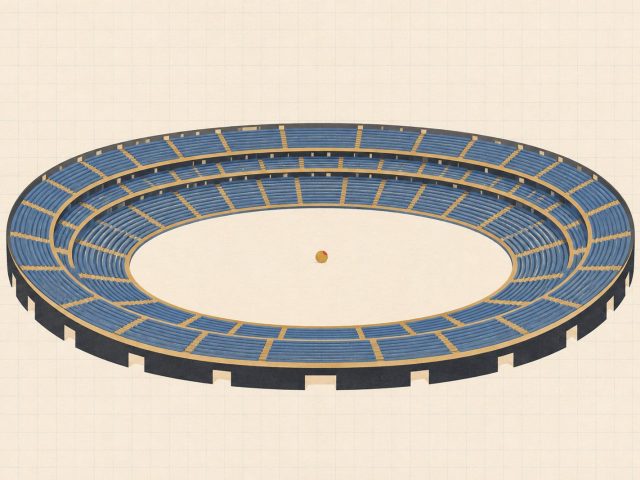
One more way to feel it. Fill a large stadium of 100,000 people. Over a lifetime, about five of them would be struck by lightning (100,000 divided by 18,864). In a year, you would need roughly fifteen such stadiums to find a single person.
Struck is not the same as killed
Most people who are hit survive. NOAA averages 22 deaths and 198 injuries a year in the 2013 to 2022 window. The National Weather Service counted 20 deaths and 96 reported injuries in 2025, against a 2015 to 2024 average of 18.6 deaths a year (NWS, 2025).
Turn deaths alone into a lifetime figure and it gets rarer still: 22 deaths a year among 332 million people is about 1 in 15 million a year, or about 1 in 190,000 over 80 years. That is our own calculation from NOAA’s figures, not an official statistic. The National Safety Council says there were too few lightning deaths in 2024 to calculate its own odds.
How it stacks up against everyday risks
| Lifetime odds of dying from | Odds (NSC, 2024 data) |
|---|---|
| Heart disease | 1 in 6 |
| Cancer | 1 in 7 |
| Fall | 1 in 89 |
| Motor-vehicle crash | 1 in 101 |
| Drowning | 1 in 1,025 |
| Lightning (death, our estimate from NOAA) | about 1 in 190,000 |
A fall is about 2,000 times likelier to be your cause of death than lightning. The sky is dramatic. The staircase is the bigger risk.
The catch: you are not the average
These odds spread the whole country evenly, as if every person stood in an open field every summer day. Real risk concentrates. It depends on where you live, what you do outdoors and whether you go inside when the thunder starts. NOAA says the odds vary with location and activity. If you have already seen the clouds, your odds that day are not the yearly average.
This is why risk numbers need a label. “1 in 1.5 million” and “1 in 18,864” are the same fact in two outfits. When you see an odds figure, ask two questions: over what period, and for whom? Without those, a big number can make a real risk sound imaginary, and a small one can make a trivial risk sound urgent.
The takeaway: lightning is rare for a year and not so rare for a life, and “when thunder roars, go indoors” costs you nothing.
Sources
- NOAA, “Lightning FAQ (odds of being struck, 2013 to 2022 averages)”, JetStream. link
- National Weather Service, “Odds of Being Struck by Lightning” (2009 to 2018 data). link
- National Weather Service, “Summary of Natural Hazard Statistics for 2025”. link
- National Safety Council, “Odds of Dying (2024 Data)”, Injury Facts. link
- numbermystery.com, “One Powerball Ticket, 2,716 Stadiums”, 2026 (Powerball jackpot odds from Powerball.com).