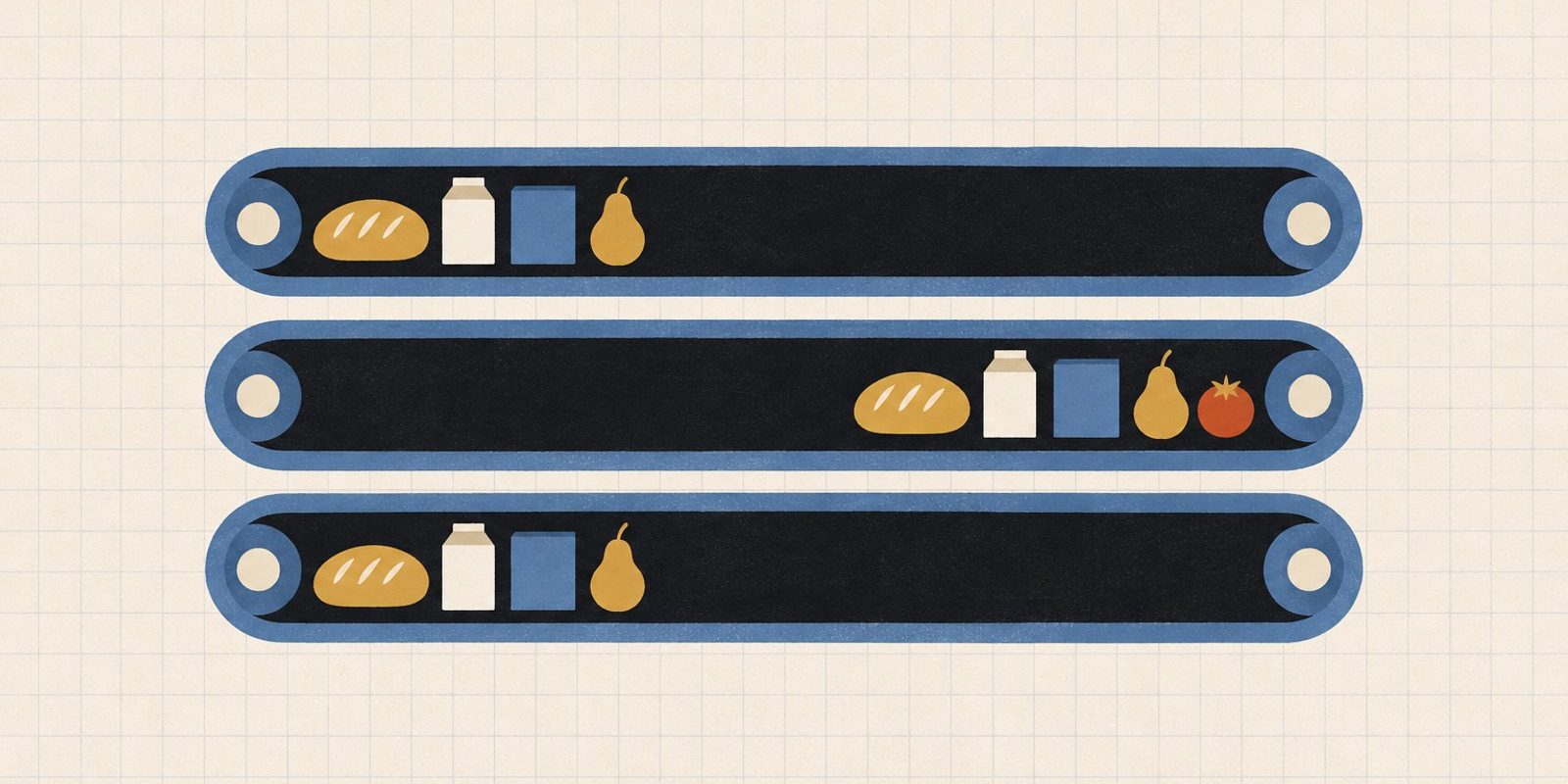
You pick the line with the shortest line of carts. Smart. Then the woman in the next lane, who showed up after you, slides her groceries onto the belt, pays and leaves. Your cashier is still hunting for a price on a bag of onions.
It feels personal. It is not. It is arithmetic, and the arithmetic is a little cruel.
The 1-in-N problem
Suppose a store has N checkout lines and they are all about equally fast. Before anyone starts checking out, every line has the same shot at being the one that finishes first. So the chance that yours is the fastest is 1 in N.
With 2 lines, that is 1 in 2. With 3 lines, it is 1 in 3. With 5 lines, it is 1 in 5. Flip it around and the odds look worse: with 5 lines, there is a 4-in-5 chance that at least one line beats yours.
Here is the part that stings. You only notice the lines that beat you. When you are ahead, you are looking at your phone or your cart. When you are behind, you are watching the neighbor lane glide by. Your memory keeps the second kind of moment, so “the other line is always faster” feels like a law of nature. It is closer to a law of attention, and I can’t point to a study that measures it for grocery stores, so treat that part as a plausible explanation, not a proven one.
One line to rule them all
Many banks, airports and fast-food counters use a single “serpentine” line that feeds the next open window. Operations researchers have long favored this design, and the math explains why. MIT’s Richard Larson, in a 1987 paper in the journal Operations Research, argued that the serpentine is also fairer, because it is strictly first come, first served. Nobody can feel they chose the wrong line, because there is no choice to make.
A small model shows the speed gain. Say each of two cashiers takes 1 minute per customer, and customers arrive so often that each cashier is busy 90% of the time. With two separate lines, a customer spends about 10 minutes in the system, waiting plus paying. Merge them into one line feeding both cashiers and that falls to about 5.3 minutes. Same people, same cashiers, almost half the time. That comes from standard queueing formulas for these textbook cases, not from a measurement of a real store.
Little’s Law, in plain words
There is a tidy rule behind all this. John D. C. Little proved it in 1961 (Operations Research, vol. 9). It says the average number of people in a system equals the rate they arrive times the average time each one stays. Written short: L = λ × W.
Try it. If 2 shoppers walk into a store every minute and the store holds 12 of them on average, each shopper stays about 6 minutes. You never have to time anybody. Count heads, count arrivals, and the wait falls out. It holds for lines, hospital beds, web servers and traffic on a highway, as long as the system is steady over time.
| Setup | Who decides your wait? | Feels fair? |
|---|---|---|
| 3 separate lines | Luck of the draw: 1-in-3 chance of the fastest | Often not |
| One serpentine line | Order of arrival | Usually yes |
The twist: people are not machines
If the single line wins on paper, why do so many stores still use separate lanes? Part of the answer is that cashiers are people. In a lab study published in Management Science in 2018, Masha Shunko, Julie Niederhoff and Yaroslav Rosokha found that servers working a single shared queue slowed down compared with servers who each had their own line. Rosokha’s explanation: serving a shared line “is viewed as a shared task,” so some servers feel less accountable. The same study found that servers who could see the line length worked faster.
Because serving customers in a single queue line is viewed as a shared task, some servers feel less accountability.
Yaroslav Rosokha, Purdue University (Purdue Research, 2016)
That was an experiment, not a measurement of your supermarket, so it does not overturn the math. It does show why the best design on paper can lose some of its edge when real humans work inside it. A related line of work by Wharton’s Hummy Song found that an emergency department that switched from a pooled queue to dedicated queues cut waits, again because ownership changes behavior.
What to do with this
Next time the neighbor lane zips ahead, remember the odds were never in your favor. With three lanes, two out of three times someone beats you. And if the store has one snaking line, enjoy it. It is probably the fairest wait you will get.
The other line is not faster. It is just the one you are watching.
Sources
- John D. C. Little, “A Proof for the Queuing Formula: L = λW”, Operations Research 9(3), 1961, pp. 383-387. link
- Richard C. Larson, “Perspectives on Queues: Social Justice and the Psychology of Queueing”, Operations Research 35(6), 1987, pp. 895-905. link
- Masha Shunko, Julie Niederhoff, Yaroslav Rosokha, “Humans Are Not Machines: The Behavioral Impact of Queueing Design on Service Time”, Management Science 64(1), 2018, pp. 453-473. link
- Purdue University, “In the Queue”, Purdue Research feature, 2016. link
- Penn Today, “When several lines are better than one” (research by Hummy Song, Wharton). link