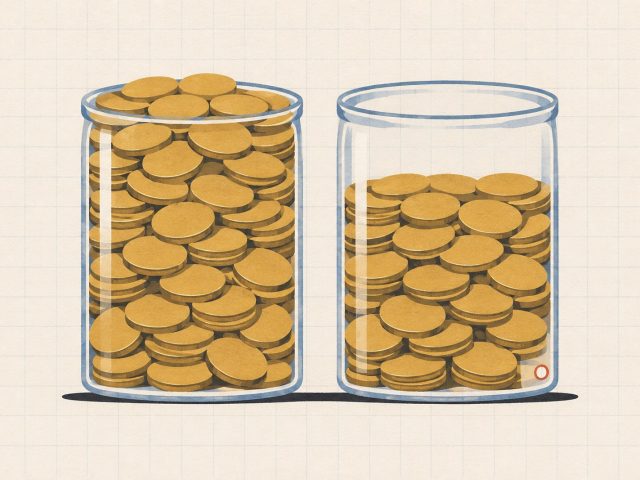
You are standing at the kitchen counter, looking at a savings account statement. A friend says her money “doubles every nine years.” You nod. Then you wonder how she did that math without a calculator, or even a pen.
She used a shortcut with a funny name: the Rule of 72. Divide 72 by the yearly growth rate and you get the number of years it takes money to double. It takes about five seconds, and it is the closest thing personal finance has to a magic trick. Every scenario below is an illustration, not a forecast.
The shortcut in action
Say you earn 8% a year. Seventy-two divided by eight is nine. Your money doubles in about nine years. At 6%, it is 12 years. At 4%, 18 years. At 2%, 36 years. The SEC’s investor education site teaches the same trick: divide 72 by the expected annual return to estimate the doubling time (Investor.gov, 2026).
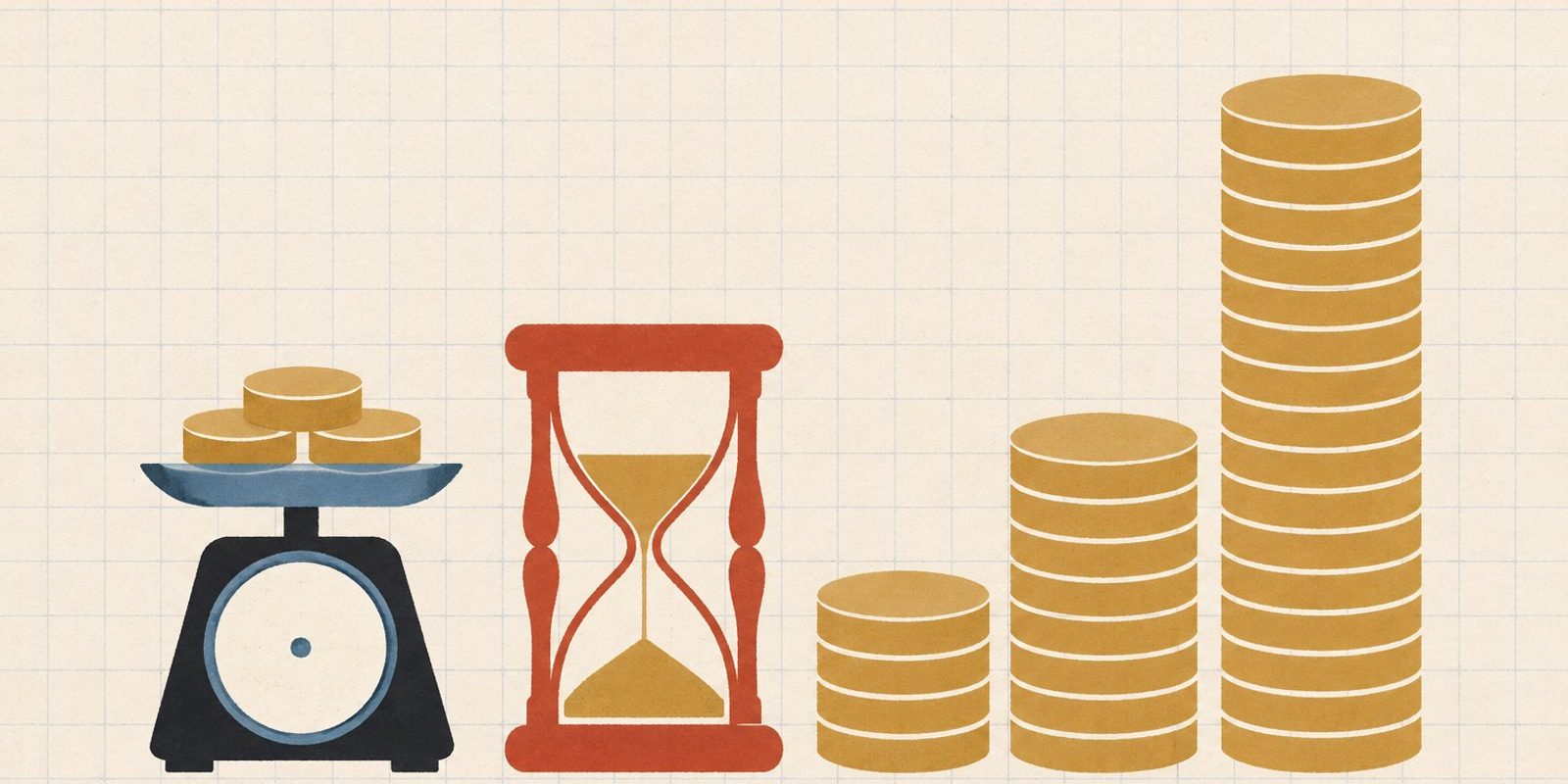
That is how a single $10,000 deposit can become $20,000, then $40,000, then $80,000 without a penny added. Each doubling is bigger than the last, because the growth earns growth.
Try it on your own life. A 401(k) that grows 6% a year doubles about every 12 years. Start at 30 and, without adding a dollar, a balance can double three times by 66. One small account turns into eight times the original. That picture is why people say time matters more than almost anything else in money.
Why 72 and not 69?
The exact doubling time is 0.693 divided by the natural log of (1 + the rate). The 0.693 is the natural log of 2. For small rates, that log is roughly the rate itself, which gives a “Rule of 69.3.” Add a small correction for compounding and the answer lands near 69.3 divided by the rate, plus about 0.35 years.
So why does everyone say 72? Because 72 divides evenly by 2, 3, 4, 6, 8, 9 and 12. Mental math gets easy. It also happens to be a near-perfect fit around 8%, where the true answer is 9.01 years.
Seventy-two is not the true number. It is the number that is easy to divide.
numbermystery.com editors (our own line, not a quote)
How close is it?
Very close in the middle, a little off at the edges. Here is the rule against the exact answer.
| Annual rate | Rule of 72 | Exact years | Rule is off by |
|---|---|---|---|
| 2% | 36.0 | 35.0 | +1.0 yr (2.8%) |
| 4% | 18.0 | 17.7 | +0.3 yr (1.9%) |
| 6% | 12.0 | 11.9 | +0.1 yr (0.9%) |
| 8% | 9.0 | 9.0 | 0.0 yr |
| 10% | 7.2 | 7.3 | -0.1 yr (-1.0%) |
Illustration, not a forecast. Across this range the rule is never off by more than about three percent. For a back-of-the-envelope tool, that is excellent.
The rule also runs backward, and that hurts
Here is the twist. The same rule tells you how fast a dollar loses half its buying power. Divide 72 by the inflation rate. The Bureau of Labor Statistics reported that consumer prices in September 2026 were 3.7% higher than a year earlier (BLS, 2026). At that pace, prices double in about 19 years. A $100 grocery run becomes $200.
One month of inflation is not a forecast, and rates change. But the lesson holds. Inflation is a doubling clock that runs against you.
You can flip it around, too. If you want money to double in 10 years, divide 72 by 10. You need about 7.2% a year. If you want it in six years, you need 12%, which is the kind of promise that should make you suspicious. High-return pitches often hide high risk, and the rule is a handy way to spot a number that is too good to be true.
Where the shortcut breaks
The rule is a tool for steady compounding. It does not fit every situation. At very low rates it drifts: the FDIC reported a national average savings rate of 0.39% in November 2026 (FDIC, 2026). The rule says 72 divided by 0.39, or about 185 years. The exact answer is about 178. Neither is a number you will live to see.
It also assumes the rate stays put and that nothing is taken out, including fees and taxes. Real returns bounce around. A stock market that “averages” 8% does not deliver 8% every year. Treat the rule as a quick sketch, not a promise.
It also flips the feeling that small differences are small. At 2%, doubling takes 36 years. At 4%, it takes 18. Two extra points cut the wait in half.
Next time someone quotes you a rate, divide it into 72. Now you know how long the wait is.
For illustration only. Not financial advice.
Sources
- U.S. Securities and Exchange Commission, Investor.gov, “Compound Interest Calculator” and compound interest resources, 2026. link
- U.S. Bureau of Labor Statistics, “Consumer Price Index Summary, September 2026”, release of October 14, 2026. link
- Federal Deposit Insurance Corporation, “National Rates and Rate Caps”, rates as of November 16, 2026. link