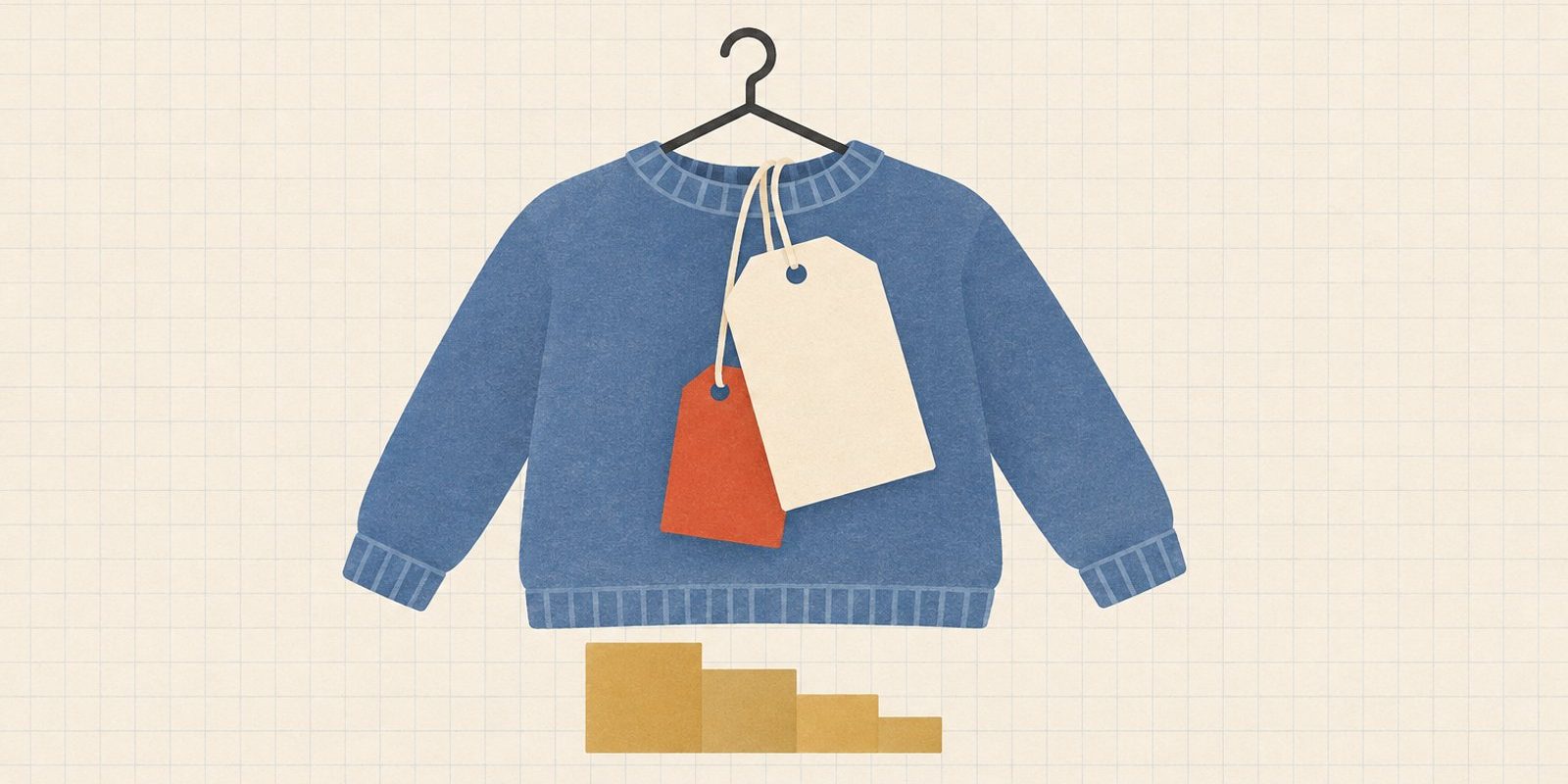
The banner over the sweater table says 30% off. The cashier taps her screen and adds, “You also have an extra 20% off coupon.” You do the sum in your head, 30 plus 20, and feel a warm glow. Half price!
It is not half price. It is 44% off. The missing six points are what this article is about.
Where the six points went
Take a $100 sweater. The first discount, 30%, knocks off $30 and leaves $70. The second discount, 20%, applies to the new price, $70. Twenty percent of $70 is $14. You pay $56. That is $44 saved, or 44% off.
The second discount is smaller in dollars than it looks, because it works on a smaller number. Shortcut: multiply what is left each time. 0.70 x 0.80 = 0.56. Order does not matter, either. Take 20% off first, then 30%, and you still land on $56.
| Stacked discounts | What shoppers add up | What you actually get |
|---|---|---|
| 10% + 10% | 20% | 19% |
| 20% + 20% | 40% | 36% |
| 30% + 20% | 50% | 44% |
| 40% + 40% | 80% | 64% |
| 50% + 50% | 100% | 75% |
Notice the gap grows as the numbers get bigger. Two 50% discounts never make an item free. They make it a quarter of the price.
The brain adds. The register multiplies.
This is not just a personal blind spot. Haipeng (Allan) Chen and Akshay Rao studied it and published the results in the Journal of Consumer Research in 2007. They found that when people face a series of percentage changes, they tend to treat the percentages like whole numbers and add them up. Two successive 25% discounts, for example, get read as 50% off. The real figure is a bit under 44%. On a $100 item, that is $56.25 instead of $50.
They make errors that can be costly.
Akshay Rao, co-author of the Journal of Consumer Research study (ScienceDaily, 2007)
Rao was describing what happens when people face more than one percentage at once.
Retailers know this
Chen and Rao also ran a retail test. They compared a 20% discount followed by an extra 25% against a single 40% discount. The math is the same: 0.80 x 0.75 = 0.60, so both are 40% off. But the stacked version drew more buyers and produced higher sales, revenue and profit (Chen and Rao, 2007). The paper’s coverage does not publish the exact lift, so no figure is quoted here. The takeaway is simple: two smaller-sounding numbers can beat one honest number, because the shopper’s mind adds them.
The twist: stacking can be a real deal
Here is the plot turn. None of this says stacked discounts are bad. A true 44% off is a big discount, bigger than a single 40%. The trick is not that the math cheats you. It is that your expectation is off. You expected 50%, got 44%, and the store got to keep the glow of a double promotion.
The fine print matters more. Some coupons apply to the original price, not the sale price. Some exclude sale items. Some are “up to.” Before you celebrate, check whether the second discount takes a bite of the first price or the second.
Percent off or dollars off?
A different mismatch: “20% off” versus “$20 off.” They are equal at exactly $100. Below that, dollars win. On a $50 item, 20% is $10, but $20 off is 40%. Above $100, percent wins: on a $300 jacket, 20% is $60, three times the $20 coupon.
Researchers David Hardesty and William Bearden found in 2003 (Journal of Retailing) that framing depends on how big the deal is. In their experiments, percentage presentations were preferred when the benefit was large, while discounts and bonus packs were rated about equally at low and moderate levels. In other words, the same savings can feel bigger or smaller depending only on whether the sign says percent or dollars.
The cure is to turn every deal into the final price. Ignore the banner. Ask what you will pay at the register.
Percentages do not add. They multiply, and the last one always applies to a smaller number.
For illustration only. Not financial advice.
Sources
- Haipeng (Allan) Chen and Akshay R. Rao, “When Two Plus Two Is Not Equal to Four: Errors in Processing Multiple Percentage Changes”, Journal of Consumer Research 34(3), 2007, pp. 327-340. link
- ScienceDaily, “People treat percentages like whole numbers” news release on the Chen and Rao study, May 2007. link
- David M. Hardesty and William O. Bearden, “Consumer evaluations of different promotion types and price presentations: the moderating role of promotional benefit level”, Journal of Retailing 79(1), 2003, pp. 17-25. link